BusinessLocal News
Ugandan Creatives Celebrate as Parliament Passes Copyright Amendment Bill
Ugandan Creatives Celebrate as Parliament Passes Copyright Amendment Bill

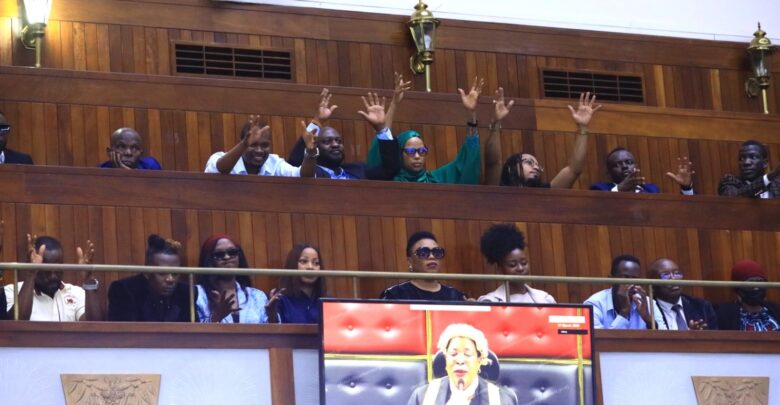
Ugandan creatives erupted in celebration after Parliament passed the Copyright and Neighbouring Rights (Amendment) Bill, 2025 during a sitting on March 17, 2026, marking a major milestone in the protection of intellectual property rights.
Artists, musicians, and authors who had gathered in the public gallery and others following proceedings from outside, welcomed the long-awaited legislation, which promises improved remuneration and stronger protections for creators.
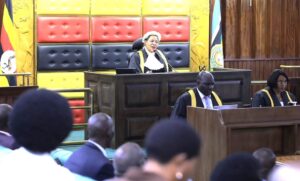
Presiding over the session, Speaker Anita Among guided the House as lawmakers adopted key amendments aimed at streamlining the collection and distribution of royalties.
One of the significant proposals, introduced by David Kabanda, grants the Minister for Justice and Constitutional Affairs authority to set procedures for collecting and distributing royalties, in consultation with the Uganda Registration Services Bureau.
The law provides that performers and producers must receive equitable remuneration whenever their work is used for commercial advertising, broadcasting, or public performance. Payments will be processed through systems established under national financial regulations, with oversight from the registrar.
The legislation also expands the mandate of collecting societies, allowing them to more effectively gather and distribute royalties to rights holders an effort aimed at ensuring fair compensation across the creative industry.
Additionally, the law introduces stricter safeguards for copyright enforcement. The registrar will not be permitted to block or remove content unless the copyright owner provides proof of registration.
Attorney General Kiryowa Kiwanuka emphasized the importance of formal registration, noting that it strengthens legal protection and makes it easier to act against infringement.
The new law imposes tougher penalties for copyright violations. Individuals found guilty of unauthorized reproduction, distribution, or broadcasting of protected works could face up to 10 years in prison, fines of up to Shs50 million, or both. Those dealing in equipment used for piracy may face up to seven years in jail or fines of up to Shs40 million.
A notable addition is the introduction of “orphan works” creative works whose owners cannot be identified or located. The law allows licensed use of such works under strict conditions, including payment of an annual fee, while ensuring that ownership rights revert to the creator if identified later.
The legislation also broadens protection to literary works such as novels, plays, and encyclopedias, while recognizing derivative works like translations, adaptations, and expressions of folklore—strengthening protection for traditional knowledge.
However, lawmakers raised concerns about the absence of provisions addressing artificial intelligence in content creation. Stephen Baka Mugabi, chairperson of the Legal and Parliamentary Affairs Committee, urged future reforms to address the growing role of AI in creative industries.
The Bill was originally introduced as a Private Member’s Bill by Hillary Kiyaga before being adopted by the government under the Ministry of Justice and Constitutional Affairs.
Justice Minister Norbert Mao moved the motion for the Second Reading, while ICT Minister Chris Baryomunsi presented it for the Third Reading, leading to its eventual passage.
The Bill now awaits assent from the President before it becomes law.
The development is widely seen as a turning point for Uganda’s creative sector, which has long advocated for stronger legal frameworks to protect intellectual property and ensure fair earnings.