International News
Germany’s Hard Right Makes History: AfD’s Saxony-Anhalt Landslide Sends Shockwaves Across Europe
Germany's Hard Right Makes History: AfD's Saxony-Anhalt Landslide Sends Shockwaves Across Europe


BERLIN — Political analysts reached for their most dramatic vocabulary on Sunday night. “Seismic.” “A socio-political earthquake.” “A watershed moment for Germany.” And for once, the hyperbole was warranted.
The Alternative for Germany — the AfD — has won a landslide victory in regional elections in Saxony-Anhalt, securing approximately 44.5 percent of the vote according to exit polls, in the most significant electoral result for a hard-right nationalist party in Germany since the fall of the Third Reich in 1945. It is a number that has stopped Europe in its tracks.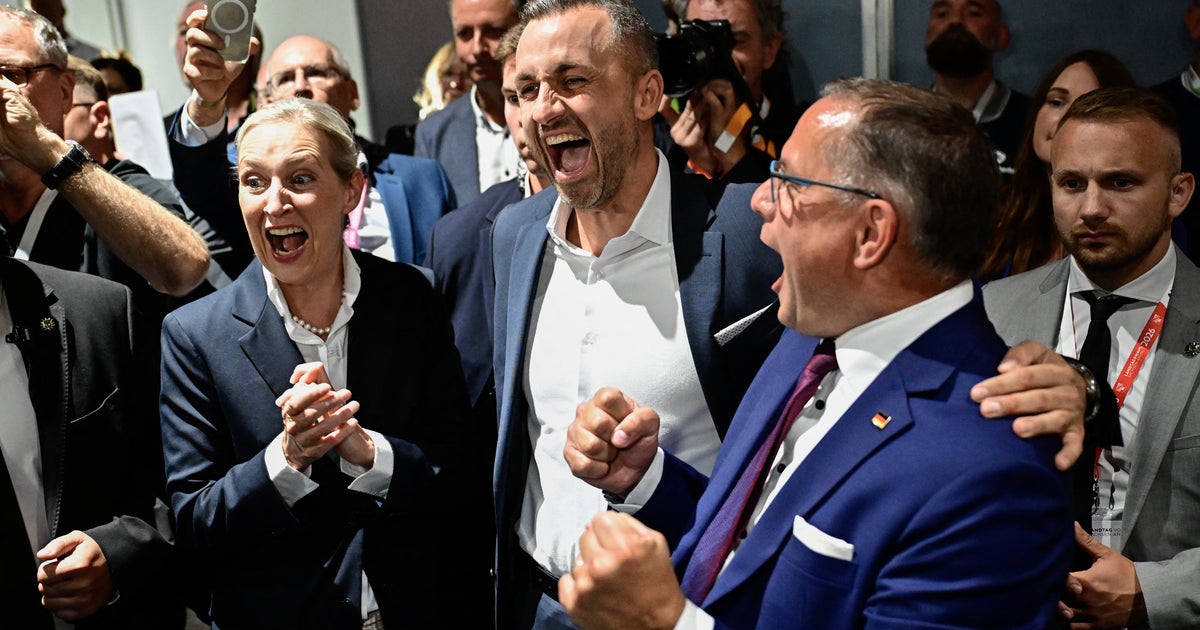
**What Happened in Saxony-Anhalt**
Saxony-Anhalt is not a large region. One of the smallest of Germany’s 16 federal states, it has 1.7 million eligible voters out of 59 million nationwide — a fraction of the German electorate. The AfD narrowly fell short of an outright majority, meaning it cannot govern alone. And yet political analysts across Germany and Europe are unanimous: the scale of what happened on Sunday cannot be explained away by geography or dismissed as a regional quirk.
AfD lead candidate Ulrich Siegmund, addressing supporters after the result, was unequivocal. The party, he said, had received a clear mandate to govern. The German establishment — which had publicly classified the AfD as in part anti-democratic, with its Saxony-Anhalt branch specifically designated as far-right extremist by German intelligence agencies — now faces the question of what to do with a party winning nearly half the votes in a German state.
**The Bigger Picture: Germany’s Political Crisis**
The Saxony-Anhalt result does not exist in isolation. The AfD is now polling as the biggest single political party at the national level across Germany — a country of 84 million people and the European Union’s largest economy. That is not a regional story. That is a national emergency for the German political mainstream.
The result is devastating for Chancellor Friedrich Merz and the centrist coalition government in Berlin. Merz had explicitly promised — one of his central electoral commitments — that he would slash the AfD’s popularity. He has not. He may now struggle to survive politically. A deeply unpopular government, already beleaguered by economic anxieties and policy failures, has just watched the far-right party it pledged to diminish achieve its greatest electoral result on German soil in the post-war era.
Germany is already weakened by internal political conflict at the precise moment Europe needs it to be at its strongest. Russia’s war in Ukraine continues without resolution. Donald Trump’s tariff turbulence has disrupted transatlantic trade frameworks. China’s economic challenge looms over the European manufacturing base. Germany — the EU’s most powerful member and its essential political anchor — is now absorbed in a crisis of democratic confidence that will consume its political class for months.
**The Trump Dimension**
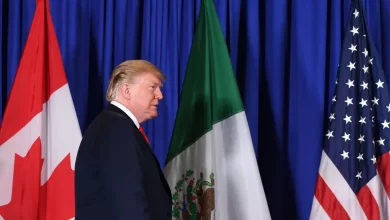
Within hours of the Saxony-Anhalt exit polls being published, Donald Trump shared the result on his Truth Social platform — an intervention that was immediate, deliberate and politically loaded.
It was not coincidental. The AfD’s political ideology maps closely onto Trump’s MAGA movement in ways that European mainstream politicians find deeply uncomfortable. Anti-immigration populism. Attacks on the mainstream media as dishonest and biased. Challenges to the independence of judges. Promises to restore a mythologised national greatness. A declared hostility to what the party terms “woke” cultural politics. And a posture of deliberate cultural aggression toward the liberal democratic consensus that has governed Western Europe since 1945.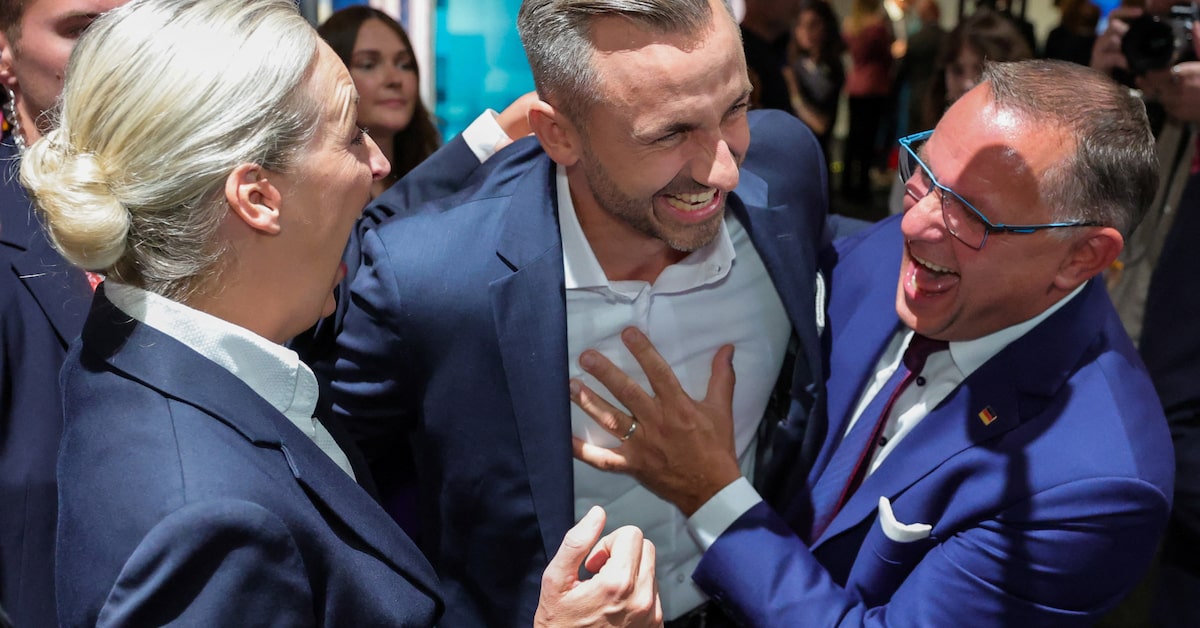
The AfD borrows from the Trump playbook — and Trump, in sharing the Saxony-Anhalt result within hours of its declaration, returned the favour. It is a transatlantic alliance of the nationalist right that European capitals have been watching with mounting anxiety for years, and that Sunday’s result has made impossible to ignore.
**The Historical Shadow**
The Saxony-Anhalt result has provoked a conversation that Germany handles with particular care and particular anguish: its own history.
Germany’s Nazi past is not a distant abstraction. It is a living presence in German public life — embedded in education curricula, in the country’s Basic Law, in its post-war constitutional architecture, in the existence of institutions specifically designed to prevent the recurrence of authoritarian government. The German political mainstream — left, centre and conservative — has maintained a formal cordon around the AfD since the party’s rise, refusing to enter coalition with it or treat its victories as a normal rotation of political power.
Sunday’s result makes that cordon increasingly difficult to sustain arithmetically. A party winning 44.5 percent in a regional election cannot be permanently quarantined from governance without a democratic cost of its own. The question of what German democracy does with a far-right party of this size — whether to engage it, isolate it or attempt to ban it — is now the central question of German politics, and by extension, of European politics.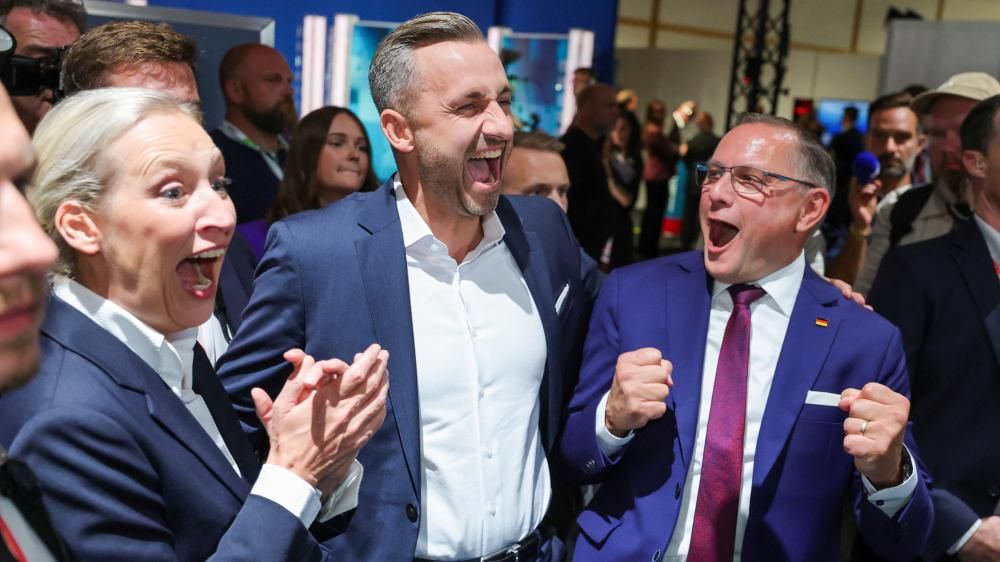
**Europe’s Broader Far-Right Surge**
Germany is not alone. Sunday’s result is one data point in a pattern that has been building across the continent for a decade. In France, Marine Le Pen’s Rassemblement National has repeatedly come close to the presidency and governs significant sections of the country at regional and municipal level. In Italy, Giorgia Meloni’s Brothers of Italy — a party with post-fascist roots — leads the government in Rome. In the Netherlands, Geert Wilders’ Party for Freedom became the largest party in the 2023 elections. In Hungary, Viktor Orbán has governed continuously since 2010, systematically dismantling democratic checks while remaining inside the EU. In Sweden and Finland, far-right parties have entered mainstream government coalitions.
The European centre — the coalition of centrist Christian Democrats, Social Democrats and Liberals that built the post-war European project — is under sustained pressure from both flanks, and losing ground across the continent to nationalist movements that share a common vocabulary: sovereignty over integration, borders over openness, national identity over multicultural pluralism.
The AfD’s landslide in Saxony-Anhalt is, for now, a regional result. But it is a regional result in Germany — the country that anchors the European Union — and it is a result that no European leader awoke to on Monday morning without a sense of deepening unease.
What Germany does next will determine far more than the politics of one small eastern state.
SOURCE BBC NEWS